
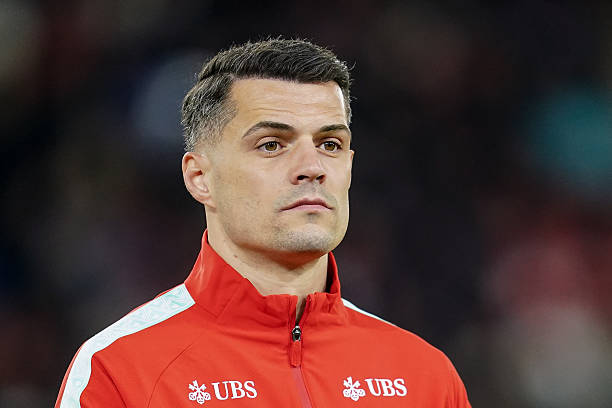
When people search “who is Granit Xhaka,” they usually expect a simple answer – a Swiss footballer, a midfielder known for leadership, aggression, and long-range passing. But if you ask football fans who have followed his career closely, they will tell you something very different. Granit Xhaka is not just another midfielder. He is one of modern football’s most polarizing, emotional, and fascinating personalities.
Granit Xhaka has spent much of his career living between praise and criticism. He has been adored by fans, heavily criticized by pundits, and repeatedly written off, only to come back stronger every time. His story is not just about football. It is about identity, resilience, redemption, and the ability to survive pressure at the highest level.
That is what makes his journey worth telling.
Who Is Granit Xhaka? The Story of Football’s Fiercest Midfield Leader
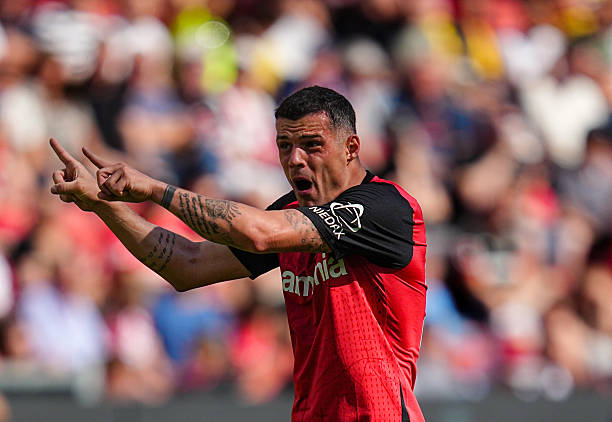
Known for his leadership and game intelligence, Granit Xhaka constantly communicates with teammates, helping control tempo and organize midfield structure.
(Photo by Ulrik Pedersen/NurPhoto via Getty Images)
From Basel to Big Dreams
Granit Xhaka was born on 27 September 1992 in Basel to a family of Albanian heritage with roots in Kosovo. His upbringing played a huge role in shaping the person he would become. Pride, discipline, loyalty, and resilience were values deeply embedded in his household, and those qualities later became visible in the way he played football.
From a young age, football became the center of his world. Unlike flashy young talents who rely on speed or dribbling, Xhaka’s biggest strength was always his football brain. He could read the game, spot passing lanes, and understand space far earlier than most players his age.
His journey through the academy of FC Basel quickly showed coaches that he was different. Even as a teenager, he carried himself like a leader. He looked calm under pressure and played with unusual maturity. Basel became the foundation of a career that would eventually take him across Europe.
Germany: Where Talent Met Discipline
In 2012, Xhaka made an important move to Borussia Mönchengladbach, entering the highly competitive Bundesliga. The move challenged him in ways Swiss football never had.
Germany exposed both his brilliance and his flaws.
His passing range and tactical intelligence immediately impressed people, but his aggressive nature also brought problems. He could be reckless in tackles, overly emotional during tense moments, and vulnerable during quick transitions.
For a while, critics questioned whether his temperament would stop him from becoming elite.
Instead, Germany became the place where raw talent matured into controlled aggression. Xhaka learned to channel his intensity more effectively. He improved tactically, became more disciplined, and slowly established himself as one of Europe’s best deep-lying midfielders.
By the time English clubs came calling, Xhaka had become a serious name in European football.
Arsenal: Fame, Pressure, and Heavy Criticism
In 2016, Arsenal F.C. signed Granit Xhaka. This transfer changed his career forever.
At Arsenal, Xhaka became one of the Premier League’s most divisive players. On some days, he looked world-class. His long-range passing controlled matches, and his powerful left foot produced spectacular goals. On other days, he made costly mistakes that frustrated fans.
This inconsistency created a complicated relationship with supporters.
The lowest point came in 2019. During a substitution, sections of Arsenal’s home crowd booed him. Xhaka reacted emotionally, shouting back at supporters and walking off angrily. The incident exploded across football media.
Many believed his Arsenal career was finished.
For most players, moments like that become permanent scars.
For Xhaka, it became the beginning of redemption.
How Mikel Arteta Reinvented Granit Xhaka
When Mikel Arteta took charge of Arsenal, he recognized something important that many others had missed.
The problem was not Xhaka.
The problem was how Xhaka was being used.
For years, Xhaka had often played as a lone defensive midfielder, a traditional number 6 role that exposed his lack of acceleration. Whenever opponents launched fast counter-attacks, he often found himself isolated, forcing desperate tackles and defensive errors.
Arteta changed everything.
Instead of anchoring midfield alone, Xhaka was moved into a more advanced left-sided role. With Thomas Partey protecting the defense behind him, Xhaka suddenly had freedom to press higher, attack spaces, create chances, and influence the final third.
The transformation was remarkable.
The same player who had once been criticized as a defensive liability became one of Arsenal’s most important leaders. Arteta didn’t change Xhaka’s identity, he simply created a tactical system that finally highlighted his strengths.
Brother vs Brother: The Emotional Euro 2016 Story
Football often creates stories bigger than sport itself.
One of the most emotional chapters of Xhaka’s career came during UEFA Euro 2016, when Switzerland faced Albania national football team.
The match carried extraordinary emotional weight.
Granit represented Switzerland.
His older brother Taulant represented Albania.
Two brothers stood on opposite sides of one of Europe’s biggest football stages.
Their mother became part of the global story when cameras showed her wearing a jersey split between Swiss and Albanian colors. That image quickly became iconic, symbolizing family, identity, and the emotional complexity of modern international football.
It was a moment that transcended sport.
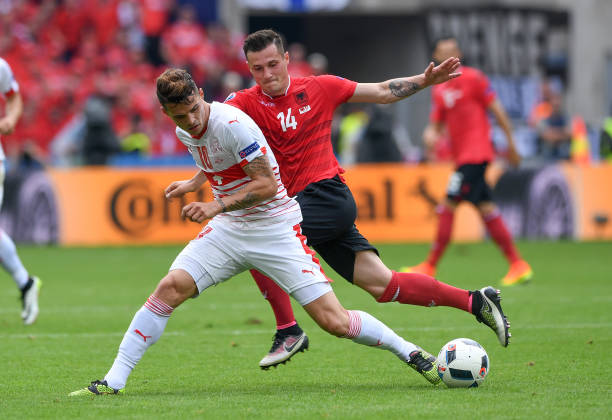
Granit Xhaka made history at Euro 2016 by facing his brother Taulant Xhaka in a rare brother-versus-brother international clash. (Photo by Pressefoto Ulmerullstein bild via Getty Images)
The Double Eagle Controversy
If there is one controversy forever linked with Granit Xhaka, it is the Double Eagle celebration.
During the 2018 FIFA World Cup, Switzerland faced Serbia national football team in a politically charged match. Xhaka scored a stunning long-range goal before celebrating with the Double Eagle gesture, symbolizing the Albanian flag.
The reaction was immediate.
Because of the sensitive political history involving Kosovo, Albania, and Serbia, the celebration triggered massive global debate. Football headlines turned political almost overnight. FIFA eventually fined players involved in the incident.
The controversy reminded the world that Xhaka’s identity goes beyond football. His heritage has always remained a deeply personal part of who he is.
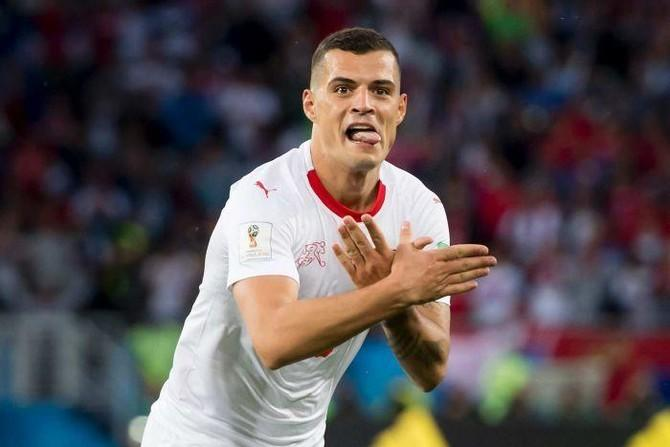
Xhaka’s Double Eagle gesture remains one of the most discussed celebrations of his career, symbolizing his Albanian heritage.
(Photo: Getty Images)
The Night Switzerland Shocked France
Some matches define careers.
For Granit Xhaka, that match came at UEFA Euro 2020.
Switzerland faced reigning world champions France national football team in the Round of 16. Almost nobody expected Switzerland to win.
Xhaka delivered the performance of his life.
Against stars like N’Golo Kanté and Paul Pogba, he completely controlled the midfield battle. He dictated tempo, resisted pressure, and led his teammates with composure.
When Switzerland completed a historic comeback and eliminated France on penalties, Xhaka’s place in Swiss football history changed forever.
That night turned him into a national legend.
Bayer Leverkusen and Football Immortality
If Arsenal gave Xhaka redemption, Bayer 04 Leverkusen gave him immortality.
Under Xabi Alonso, Xhaka became the heartbeat of one of Europe’s most extraordinary teams.
Leverkusen achieved the impossible. They completed an unbeaten domestic season, winning both the Bundesliga and DFB-Pokal. For a club long mocked as “Neverkusen,” it was a historic transformation.
Xhaka played a central role in this success. He controlled the rhythm of matches, stabilized transitions, and gave structure to Xabi Alonso’s tactical system. Many analysts considered him the most important signing of that historic campaign.
By then, the football world had stopped questioning his quality.
His legacy had become undeniable.
Switzerland’s Record-Breaking Captain
Granit Xhaka’s importance to Switzerland cannot be measured by performances alone.
He became the most-capped player in Swiss football history, surpassing legendary midfielder Heinz Hermann.
Breaking that record means far more than simply playing many matches. It reflects trust, consistency, and leadership across multiple generations.
For years, whenever Switzerland needed direction, Xhaka was there.
That says everything.
What Is Granit Xhaka Doing Now?
Even after achieving legendary status with Bayer 04 Leverkusen, Granit Xhaka’s career has continued to surprise football fans.
Following Xabi Alonso’s departure from Leverkusen to join Real Madrid CF in the summer of 2025, Xhaka made a shock return to English football by signing for Sunderland A.F.C.. Many initially viewed the move as an unexpected late-career decision, but Xhaka once again proved why writing him off is always risky.
Instead of slowing down, he immediately became the heartbeat of Sunderland’s squad. His leadership, experience, and composure transformed the team’s midfield, and he was soon named club captain. Under his guidance, Sunderland produced one of the biggest surprises of the 2025–26 Premier League season, finishing in an extraordinary seventh place and securing qualification for European football through the UEFA Europa League.
For a club that had spent years fighting to rebuild its identity, Xhaka became the symbol of ambition and belief.
Yet even that remarkable season has been overshadowed by the drama surrounding his future.
As of June 2026, Xhaka finds himself at the center of one of football’s biggest transfer sagas. Chelsea F.C. have reportedly launched a surprise €30 million bid to sign the Swiss midfielder. The move is being driven by incoming manager Xabi Alonso, who is eager to reunite with the player who helped anchor his historic Bayer Leverkusen side.
Reports suggest Xhaka has already reached a verbal agreement on personal terms with Chelsea, fueling speculation that a reunion with Alonso could soon become reality. However, Sunderland are determined to keep their captain and are expected to resist attempts to sell one of their most influential players.
Away from club football, Xhaka remains focused on international duty.
He is currently captaining Switzerland national football team at the 2026 FIFA World Cup in North America, where Switzerland have successfully progressed through the group stage and qualified for the Round of 32. That means his immediate focus remains on leading his country deeper into the tournament before making any final decision about his club future.
At 33, Granit Xhaka continues to prove something that has defined his entire career—while others keep predicting the end of his story, he keeps writing new chapters.
People also read:







 Because entertainment never stops! CelebsAdda brings you fast, reliable, and spicy updates from the world of cinema, television, and celebrity culture anytime, anywhere.
2 Responses