
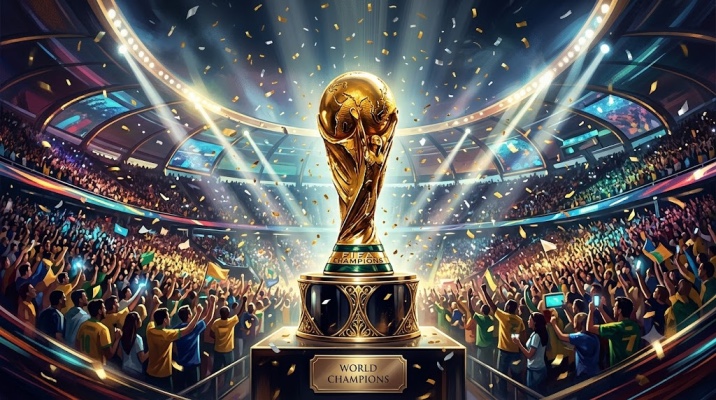
FIFA World Cup History: The Complete Story of Football’s Greatest Tournament
The FIFA World Cup history began in 1930, when just 13 nations gathered in Uruguay to compete for football’s highest honour. What started as a relatively small international tournament has since evolved into the world’s biggest sporting event, attracting billions of viewers and millions of fans from every corner of the globe. Today, lifting the FIFA World Cup Trophy is considered the ultimate achievement in international football.
Over nearly a century, the tournament has witnessed remarkable transformations. It has survived world wars, expanded from 13 to 48 participating teams, introduced new technologies like VAR and goal-line technology, and produced iconic champions including Brazil, Germany, Argentina, Italy, France, and Spain. Legendary footballers such as Pelé, Diego Maradona, Zinedine Zidane, Ronaldo Nazário, Cristiano Ronaldo, Lionel Messi, and many others have all contributed unforgettable chapters to World Cup history.
In this complete guide, we’ll explore the FIFA World Cup history from its origins in the early 20th century to the modern era. We’ll look at why the tournament was created, how it has evolved over the decades, the greatest moments and players, the history of the famous World Cup trophy, and why this tournament continues to unite billions of football fans across the world.
The Birth of the FIFA World Cup
Before the FIFA World Cup existed, there was no dedicated international championship to determine the world’s best football nation. Although football had become one of the most popular sports in Europe and South America by the early 1900s, international competitions were limited, and national teams mainly competed in friendly matches or the Olympic Games.
The governing body of world football, FIFA (Fédération Internationale de Football Association), was founded in 1904 in Paris, France. Its primary goal was to organize and promote football worldwide while establishing common rules for international competition. During its early years, FIFA relied heavily on the Olympic football tournament as the highest level of international competition.
However, the Olympics had significant limitations. The football tournament was initially restricted to amateur players, preventing many of the world’s best professionals from participating. FIFA believed football deserved its own standalone championship that would welcome the strongest national teams regardless of amateur or professional status.
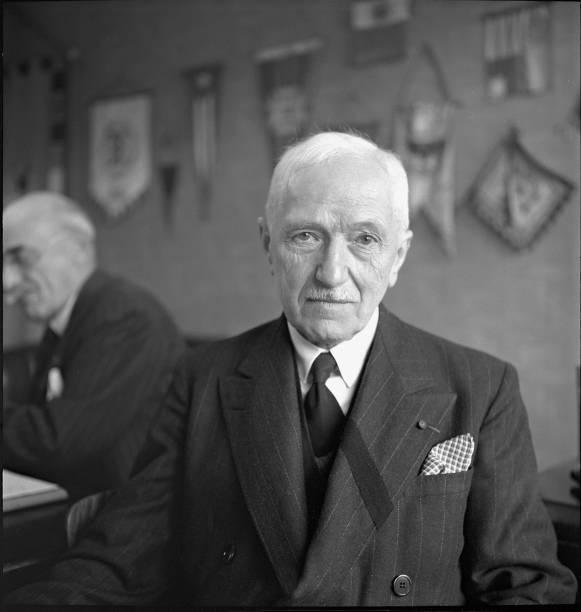
The person most responsible for turning this dream into reality was Jules Rimet, FIFA’s third president. Rimet strongly believed that football had the power to unite nations and cultures. He spent years convincing football associations around the world that an independent international tournament would help grow the sport far beyond Europe.
His persistence paid off in 1928, when FIFA officially voted to create the first FIFA World Cup.
It was a historic decision that changed football forever.
Why Uruguay Hosted the First FIFA World Cup
Once FIFA approved the tournament, the next challenge was selecting the host nation. Several European countries expressed interest, but FIFA eventually awarded hosting rights to Uruguay.
The decision surprised many at the time, but Uruguay had several advantages.
First, Uruguay had established itself as one of the strongest football nations in the world after winning the Olympic football gold medal in both 1924 and 1928. Their attractive style of play had impressed fans and experts across Europe.
Second, the country was celebrating the 100th anniversary of its Constitution in 1930. Hosting a global football tournament became part of the national celebrations.
Perhaps the biggest factor was financial. Uruguay agreed to cover travel and accommodation costs for participating teams, a significant incentive during the difficult economic conditions of the late 1920s.
Despite this support, many European teams hesitated to participate. Traveling from Europe to South America required a journey of nearly three weeks by ship. Several football associations declined the invitation because players would be away from home for almost two months.
Eventually, only four European teams accepted the invitation:
- France
- Belgium
- Romania
- Yugoslavia
The remaining participants came from North America and South America, giving the inaugural tournament a total of 13 national teams.
The First FIFA World Cup (1930)
The inaugural FIFA World Cup began on 13 July 1930 in Montevideo, Uruguay.
Unlike today’s tournaments featuring dozens of matches and multiple stadiums, the first edition was a much smaller event. The 13 participating teams were divided into four groups, with the winners advancing directly to the semi-finals.
The opening matches marked the beginning of a new era in international football. France defeated Mexico 4–1, while the United States also enjoyed a winning start. Fans quickly embraced the excitement of the new tournament, and attendance increased as the competition progressed.
Uruguay comfortably reached the final after defeating Yugoslavia 6–1 in the semi-final. Argentina secured the other place in the final with an identical 6–1 victory over the United States.
On 30 July 1930, more than 68,000 spectators packed Montevideo’s Estadio Centenario to witness the first FIFA World Cup final.
Argentina led 2–1 at half-time, but Uruguay produced an outstanding comeback in the second half to win 4–2 and become the first FIFA World Cup champions.
Captain José Nasazzi lifted the inaugural World Cup trophy, beginning a tradition that continues to this day.
Although only 13 nations participated, the tournament proved that international football could capture the imagination of fans worldwide. Its success convinced FIFA that the World Cup should become a regular competition held every four years.
The foundations of football’s greatest tournament had been firmly established.
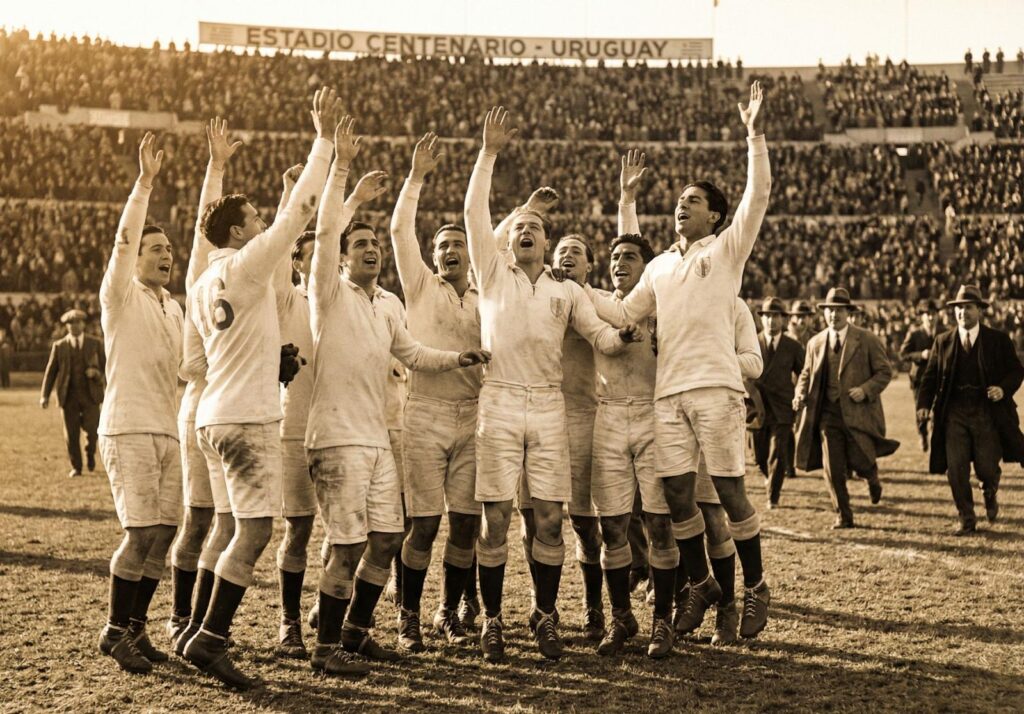
Uruguay made FIFA World Cup history by defeating Argentina 4–2 to win the first-ever World Cup in 1930.
(Source: Xbotgo)
World War II and the Missing FIFA World Cups
The FIFA World Cup was designed to take place every four years, but global events soon interrupted its growth. As Europe descended into World War II in 1939, organizing an international football tournament became impossible. Nations were focused on survival rather than sport, and many footballers joined military service or contributed to the war effort.
As a result, the 1942 and 1946 FIFA World Cups were officially cancelled. Although several countries, including Germany and Brazil, had expressed interest in hosting the 1942 tournament before the war escalated, FIFA had not selected a host nation. The destruction caused by the conflict made it clear that football would have to wait.
For twelve years, the world had no FIFA World Cup. Domestic leagues in many countries were suspended or severely disrupted, stadiums were damaged, and international travel was almost impossible. It was a difficult period for football, but the passion for the game never disappeared.
When peace gradually returned, FIFA worked to revive the tournament. The football community saw the World Cup not only as a sporting competition but also as a symbol of international unity after years of conflict.
In 1950, the FIFA World Cup finally returned, with Brazil chosen as the host nation. Fans across the globe eagerly welcomed the competition back, marking the beginning of a new chapter in FIFA World Cup history.
The Maracanazo: Football’s Greatest Upset
The 1950 FIFA World Cup remains one of the most unique tournaments ever held.
Unlike every other edition, there was no traditional final. Instead, the tournament concluded with a final group stage featuring Brazil, Uruguay, Spain, and Sweden. The team finishing first in this group would become world champion.
Brazil entered the decisive match against Uruguay as overwhelming favourites. Playing at the newly built Maracanã Stadium in Rio de Janeiro, the hosts needed only a draw to secure their first FIFA World Cup title. Newspapers had already declared Brazil the champions before the match even kicked off.
An estimated crowd of more than 170,000 spectators filled the stadium, making it one of the largest attendances in football history.
Brazil took the lead early in the second half through Friaça, and celebrations erupted across the stadium. However, Uruguay refused to surrender. Juan Alberto Schiaffino equalised before Alcides Ghiggia scored the winning goal in the 79th minute, silencing the enormous crowd.
Uruguay’s 2–1 victory became known as the Maracanazo, a Spanish term meaning “the blow at the Maracanã.”
For Brazil, it was one of the most heartbreaking defeats in sporting history. For Uruguay, it remains the country’s greatest football achievement. Even today, the Maracanazo is remembered as one of the biggest upsets ever witnessed in international football.
Pelé and Brazil’s Golden Era
If the 1950 World Cup ended in heartbreak for Brazil, the following two decades transformed the nation into football’s greatest powerhouse.
The turning point came in 1958, when a 17-year-old forward named Pelé introduced himself to the world.
Playing in Sweden, Pelé displayed extraordinary skill, confidence, and maturity despite his young age. He scored six goals during the tournament, including two in the final against the host nation. Brazil defeated Sweden 5–2 to lift its first FIFA World Cup trophy.
Pelé immediately became an international superstar and remains the youngest player ever to win the FIFA World Cup.
Brazil successfully defended its title in 1962 in Chile. Although Pelé suffered an early injury, players like Garrincha stepped up to lead the team to another championship. Brazil became only the second nation, after Italy, to win consecutive World Cups.
The country’s greatest achievement came in 1970 in Mexico.
The Brazilian team featured an extraordinary collection of talent, including Pelé, Jairzinho, Carlos Alberto, Rivellino, Gérson, and Tostão. Their attacking football captivated audiences around the world and is still regarded as one of the greatest national teams in football history.
Brazil defeated Italy 4–1 in the final, with captain Carlos Alberto scoring one of the most famous team goals ever seen in a World Cup.
Winning their third title also allowed Brazil to permanently keep the Jules Rimet Trophy, according to FIFA’s rules at the time.
Pelé retired from the World Cup with an unmatched legacy of three FIFA World Cup titles (1958, 1962, and 1970) a record no player has surpassed.
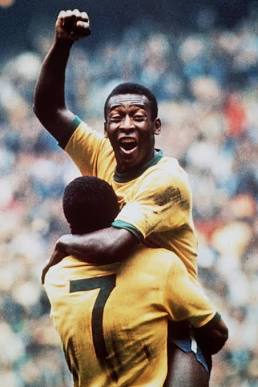
Pelé inspired Brazil to its third FIFA World Cup title in 1970, cementing the team’s place among the greatest FIFA World Cup winners.
(Source: Global Times)
England’s Historic Triumph in 1966
The 1966 FIFA World Cup was hosted by England and remains one of the most discussed tournaments in football history.
Playing on home soil, England reached the final after defeating Portugal in the semi-finals. Their opponents were West Germany, another football powerhouse.
The final at Wembley Stadium produced one of the sport’s most controversial moments.
With the score tied at 2–2 during extra time, Geoff Hurst struck a powerful shot that hit the underside of the crossbar before bouncing down near the goal line. After consulting the assistant referee, the goal was awarded, even though debate continues to this day over whether the ball completely crossed the line.
England went on to win 4–2, with Hurst becoming the first player to score a hat-trick in a men’s FIFA World Cup final.
However, that record did not remain untouched forever. During the 2022 FIFA World Cup in Qatar, France forward Kylian Mbappé scored a hat-trick against Argentina in one of the greatest finals in tournament history. The match ended 3–3 after extra time, with Argentina eventually winning on penalties, but Mbappé’s three goals made him the second player to achieve the feat in a men’s World Cup final.
More than half a century later, England’s victory in 1966 remains the country’s only FIFA World Cup title, making it one of the proudest moments in English sporting history.
Football Becomes a Global Phenomenon
During the 1960s and 1970s, the FIFA World Cup evolved far beyond a sporting competition. Television broadcasts brought live matches into homes across Europe, South America, Africa, and Asia, introducing millions of new fans to international football.
As broadcasting technology improved, the tournament’s popularity exploded. Legendary players became global icons, while national teams inspired generations of young footballers.
FIFA also expanded its efforts to make the World Cup more inclusive by increasing qualification opportunities for countries outside Europe and South America. Nations from Africa, Asia, and North America began making greater impacts on the international stage, helping transform the FIFA World Cup into a truly global event.
By the end of the 1970s, the tournament had become the biggest sporting spectacle on the planet, setting the stage for new legends, unforgettable matches, and further expansion in the decades to come.
The 1980s: A New Era for the FIFA World Cup
The 1980s marked one of the most significant periods in FIFA World Cup history. The tournament expanded to include more nations, new football powers emerged, and several of the sport’s greatest players cemented their legacies on the world’s biggest stage.
Italy’s Third World Cup Triumph (1982)
The 1982 FIFA World Cup in Spain introduced one of the biggest changes in tournament history.
For the first time, the competition expanded from 16 teams to 24 teams, allowing more countries from Africa, Asia, and North America to participate. The expansion reflected football’s growing popularity across the globe and made the World Cup even more competitive.
Italy arrived in Spain under immense pressure. The team struggled during the group stage and advanced only after drawing all three of its opening matches. Many critics doubted whether the Italians could challenge for the title.
Everything changed when striker Paolo Rossi rediscovered his form.
Rossi scored a memorable hat-trick against tournament favourites Brazil in the second group stage before adding two goals against Poland in the semi-final. In the final against West Germany, Rossi scored again as Italy secured a convincing 3–1 victory.
Italy lifted its third FIFA World Cup trophy, while Paolo Rossi finished as both the tournament’s top scorer and winner of the Golden Ball.
The 1982 tournament also proved that expanding the competition had made the World Cup more exciting and unpredictable.
Diego Maradona and the Greatest Individual World Cup (1986)
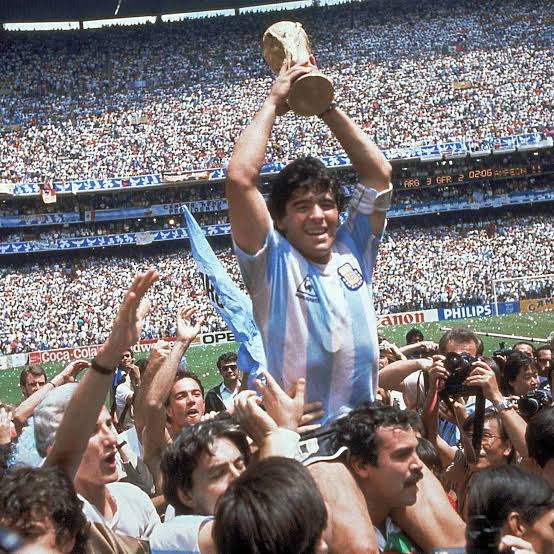
If Pelé defined the 1960s, Diego Maradona became the face of the 1986 FIFA World Cup in Mexico.
Widely regarded as one of football’s greatest players, Maradona produced a tournament that many experts still consider the finest individual performance in World Cup history.
Argentina’s captain inspired his team from start to finish, but his defining moment came in the quarter-final against England.
Within just four minutes, Maradona scored two of football’s most famous goals.
The first became known as the “Hand of God,” as he illegally punched the ball into the net. Although controversial, the goal stood because the referee did not see the handball.
Moments later, Maradona produced something completely different.
Collecting the ball inside his own half, he dribbled past five England players before scoring what FIFA later called the “Goal of the Century.”
Argentina defeated England 2–1 before going on to beat Belgium in the semi-final and West Germany 3–2 in the final.
Maradona finished the tournament with five goals and five assists, almost single-handedly leading Argentina to its second FIFA World Cup title.
Nearly four decades later, his performances in Mexico remain one of the greatest examples of individual brilliance in football history.
(Source: Al Jazeera)
Germany’s Consistency and the Rise of Modern Football
Throughout the 1980s and early 1990s, West Germany established itself as one of the most consistent teams in international football.
After finishing runners-up in both 1982 and 1986, the Germans finally lifted the trophy at the 1990 FIFA World Cup in Italy.
The final was a rematch of the previous tournament, once again featuring Argentina and West Germany.
This time, Andreas Brehme scored the only goal of the match from a late penalty, giving West Germany a 1–0 victory.
Captain Lothar Matthäus lifted the trophy, while coach Franz Beckenbauer achieved a remarkable feat by winning the FIFA World Cup both as a player and as a manager.
The 1990 tournament also marked the end of an era, as it was the final World Cup contested by West Germany before German reunification.
Brazil’s Return to the Top (1994)
After winning the tournament in 1970, Brazil waited 24 years before lifting another FIFA World Cup trophy.
The 1994 FIFA World Cup, hosted by the United States, introduced football to millions of new fans across North America.
Brazil reached the final against Italy in a match remembered for its defensive discipline rather than attacking flair.
For the first time in FIFA World Cup history, the final ended 0–0 after extra time, forcing a penalty shootout.
Brazil won 3–2 on penalties, securing its fourth World Cup title.
The defining image of the final came when Italian star Roberto Baggio missed the decisive penalty, sending Brazil into celebration.
Captain Dunga lifted the trophy, while Romário’s outstanding performances earned him the Golden Ball as the tournament’s best player.
France Announces Its Arrival (1998)
The 1998 FIFA World Cup in France introduced another historic change.
The tournament expanded once again, this time from 24 teams to 32 teams, allowing more nations than ever before to compete on football’s biggest stage.
France, playing in front of passionate home supporters, enjoyed an unforgettable campaign.
Led by players such as Zinedine Zidane, Didier Deschamps, Lilian Thuram, and Fabien Barthez, the hosts reached the final against defending champions Brazil.
Many expected Brazil to win, but France dominated the match from the opening whistle.
Zidane scored two headers before Emmanuel Petit added a late goal to complete a 3–0 victory.
France celebrated its first FIFA World Cup title, while Zidane became one of the greatest heroes in French sporting history.
The success of the 1998 tournament confirmed that the expanded 32-team format had created a more diverse and globally competitive competition.
Ronaldo Nazário’s Greatest Comeback (2002)
Few stories in FIFA World Cup history are as inspiring as Ronaldo Nazário’s comeback.
During the 1998 World Cup, Ronaldo was considered the world’s best player, but his mysterious medical episode before the final against France overshadowed Brazil’s defeat.
Over the following four years, he suffered two devastating knee injuries that threatened to end his career.
Many believed Ronaldo would never return to his previous level.
He proved everyone wrong.
At the 2002 FIFA World Cup, co-hosted by Japan and South Korea, Ronaldo rediscovered his incredible finishing ability.
He scored eight goals, including both goals in Brazil’s 2–0 victory over Germany in the final.
Supported by Rivaldo, Ronaldinho, Cafu, and Roberto Carlos, Ronaldo helped Brazil claim a record fifth FIFA World Cup title, a record that still stands today.
His remarkable comeback remains one of the greatest redemption stories in sports history.
Spain’s Golden Generation Changes Football (2010)
The 2010 FIFA World Cup in South Africa was historic for several reasons. It was the first FIFA World Cup hosted on the African continent, marking a major milestone in the tournament’s global expansion. Fans from around the world experienced South Africa’s vibrant culture, while the unforgettable sound of the vuvuzelas became one of the defining memories of the competition.
On the pitch, Spain completed one of the greatest eras in international football.
Having already won the UEFA European Championship in 2008, Spain entered the tournament with a squad filled with exceptional talent, including Xavi Hernández, Andrés Iniesta, Iker Casillas, Sergio Busquets, David Villa, Xabi Alonso, and Carles Puyol.
Although Spain surprisingly lost its opening match to Switzerland, the team recovered brilliantly. Their patient passing style, famously known as “tiki-taka,” controlled possession and frustrated opponents throughout the tournament.
In the final against the Netherlands, both teams fought an intense battle that remained goalless after 90 minutes. During extra time, Andrés Iniesta scored the decisive goal in the 116th minute, giving Spain a 1–0 victory and its first FIFA World Cup title.
Spain’s success inspired clubs and national teams around the world, influencing modern football tactics for years to come.
Germany’s Historic 7–1 Victory and Fourth World Cup (2014)
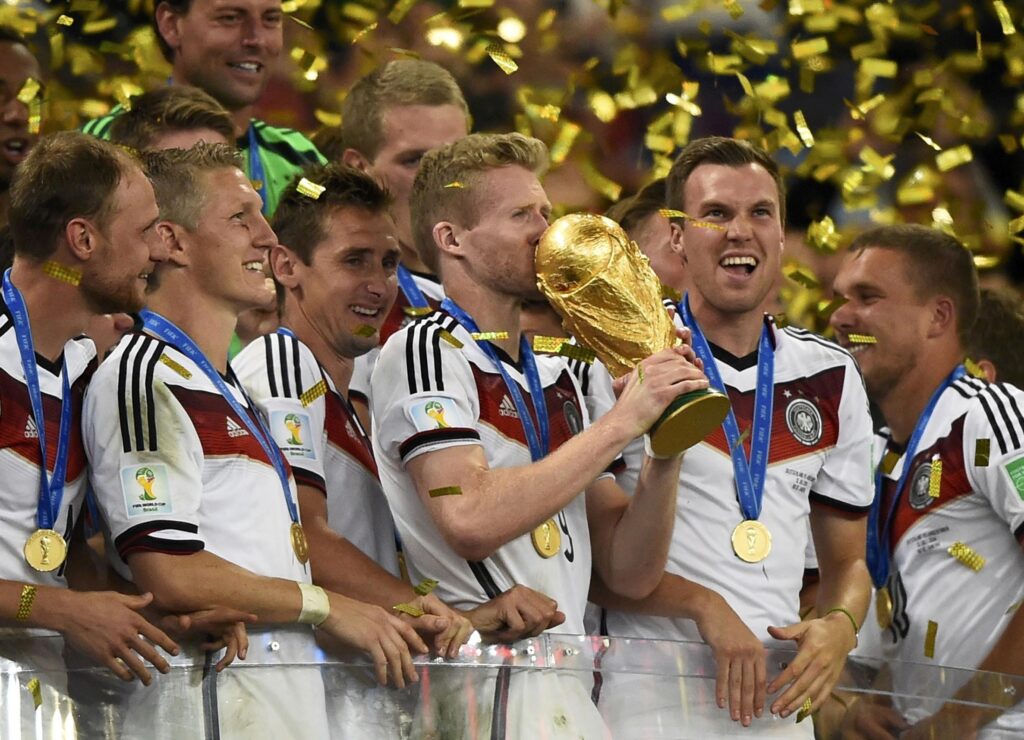
Germany claimed its fourth World Cup title in Brazil in 2014 after Mario Götze’s dramatic extra-time winner against Argentina.
(Source: Getty Images)
The 2014 FIFA World Cup in Brazil produced one of the most shocking matches in football history.
Brazil, playing on home soil, carried the hopes of millions of supporters. After losing Neymar to injury before the semi-final, they faced a confident German team featuring Manuel Neuer, Philipp Lahm, Toni Kroos, Thomas Müller, Mesut Özil, and Miroslav Klose.
What happened next stunned the football world.
Germany scored five goals within the first 29 minutes, leaving Brazil completely overwhelmed. The match eventually ended 7–1, the heaviest defeat Brazil has ever suffered in a World Cup and one of the greatest upsets in modern football history.
The victory became known simply as the “Mineirazo,” drawing comparisons with the Maracanazo of 1950 because of the heartbreak experienced by Brazilian fans.
Germany carried that momentum into the final against Argentina.
With the match still tied after 90 minutes, substitute Mario Götze controlled André Schürrle’s cross on his chest before volleying the ball into the net during extra time.
Germany won 1–0, securing its fourth FIFA World Cup title.
The tournament also saw Miroslav Klose become the highest goalscorer in FIFA World Cup history, surpassing Brazil’s Ronaldo with his 16th World Cup goal.
France’s Young Stars Shine in Russia (2018)
The 2018 FIFA World Cup in Russia showcased the rise of a new generation of football stars.
France entered the tournament with one of the youngest and most talented squads in the competition. Under manager Didier Deschamps, Les Bleus combined youthful energy with tactical discipline.
Young forward Kylian Mbappé became one of the tournament’s biggest attractions. His blistering pace, fearless dribbling, and clinical finishing helped France eliminate Argentina in an unforgettable Round of 16 match before continuing their impressive run to the final.
France faced Croatia in Moscow, where Luka Modrić had inspired his nation to its first-ever World Cup final.
The final proved entertaining from start to finish.
France defeated Croatia 4–2, becoming FIFA World Cup champions for the second time after their maiden triumph in 1998.
Mbappé scored in the final, becoming only the second teenager after Pelé to score in a men’s FIFA World Cup final.
Lionel Messi Completes Football’s Greatest Journey (2022)
Few stories in FIFA World Cup history have captured the imagination of football fans like Lionel Messi’s pursuit of the World Cup trophy.
Having experienced disappointment in 2006, 2010, and the heartbreaking defeat in the 2014 final, Messi arrived at the 2022 FIFA World Cup in Qatar knowing it would likely be his final opportunity to become world champion.
Argentina’s campaign began unexpectedly with a shock defeat against Saudi Arabia in the group stage.
Rather than collapsing under pressure, the team responded magnificently.
Led by Messi, Argentina defeated Mexico, Poland, Australia, the Netherlands, Croatia, and eventually reached the final against defending champions France.
The final is widely regarded as one of the greatest football matches ever played.
Messi scored twice, while France’s Kylian Mbappé produced a sensational hat-trick. After an incredible 3–3 draw following extra time, the match was decided by a penalty shootout.
Argentina won 4–2 on penalties, securing its third FIFA World Cup title.
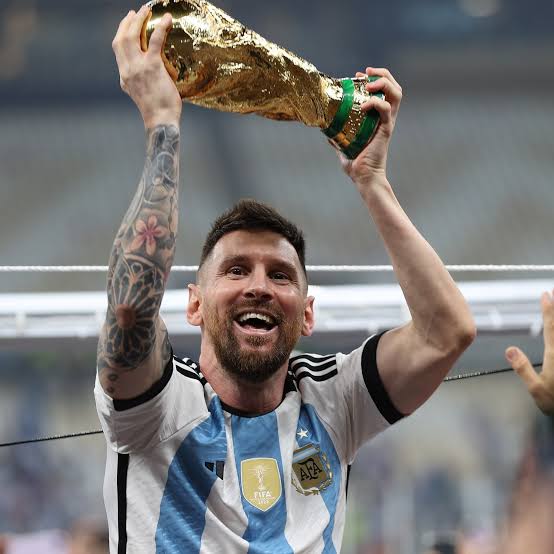
When Lionel Messi finally lifted the FIFA World Cup Trophy, it completed one of the greatest careers in football history. His emotional celebration became one of the tournament’s defining images and fulfilled a dream shared by millions of football fans around the world.
The Evolution of the FIFA World Cup Trophy
The trophy awarded to the world’s champions has changed over the decades, reflecting the tournament’s rich history.
The Jules Rimet Trophy (1930–1970)
The original FIFA World Cup trophy was named after Jules Rimet, the FIFA president whose vision helped create the tournament.
Designed by French sculptor Abel Lafleur, the trophy featured Nike, the Greek goddess of victory, holding an octagonal cup above her head.
According to FIFA’s rules at the time, any nation winning the World Cup three times would permanently keep the trophy.
Brazil achieved that milestone in 1970 after defeating Italy in the final.
Sadly, the Jules Rimet Trophy was stolen from the Brazilian Football Confederation’s headquarters in 1983 and has never been recovered. It is widely believed to have been melted down.
The Modern FIFA World Cup Trophy
Following Brazil’s permanent ownership of the Jules Rimet Trophy, FIFA introduced a new design in 1974.
Created by Italian sculptor Silvio Gazzaniga, the current trophy depicts two human figures lifting the Earth, symbolizing the unity and global spirit of football.
The trophy stands approximately 36.8 centimetres tall, weighs 6.175 kilograms, and is made primarily of 18-carat gold with a base of malachite.
Unlike its predecessor, the original FIFA World Cup Trophy remains FIFA’s property. Winning teams receive the trophy during the presentation ceremony before returning it to FIFA, while champions are awarded a gold-plated replica to keep permanently.
Technology Transforms the Modern World Cup
As football evolved, so did the technology used to officiate matches.
The FIFA World Cup has introduced several innovations aimed at improving fairness and accuracy.
These include:
- Goal-line technology, first used at the 2014 FIFA World Cup, ensuring referees know instantly whether the ball has crossed the goal line.
- Video Assistant Referee (VAR), introduced at the 2018 FIFA World Cup, allowing officials to review important decisions involving goals, penalties, red cards, and mistaken identity.
- Semi-automated offside technology, first used at the 2022 FIFA World Cup, making offside decisions faster and more accurate.
Although these technologies continue to spark debate among fans, they have significantly reduced major officiating errors and improved decision-making at football’s highest level.
FIFA World Cup Records That Shaped Football History
Throughout its long and fascinating journey, the FIFA World Cup has produced countless records that continue to inspire football fans around the globe. While many achievements have been surpassed over the years, some records remain unmatched and may never be broken.
Here are some of the most remarkable milestones in FIFA World Cup history.
| Record | Achievement |
|---|---|
| Most FIFA World Cup titles | Brazil (5) |
| Most World Cup final appearances | Germany (8) |
| Most goals in FIFA World Cup history | Miroslav Klose (16) |
| Most World Cup appearances by a player | Lionel Messi (26 matches) |
| Only player to win three World Cups | Pelé |
| Youngest World Cup winner | Pelé (17 years, 249 days) |
| First African host nation | South Africa (2010) |
| First Asian co-hosts | South Korea & Japan (2002) |
| First Middle Eastern host | Qatar (2022) |
| Largest tournament | 2026 FIFA World Cup (48 teams) |
These achievements reflect not only individual brilliance but also the continuous evolution of football over nearly a century.
How the FIFA World Cup Changed Football Forever
The FIFA World Cup is much more than a football tournament. It has transformed the sport into a truly global phenomenon and influenced cultures, economies, and generations of supporters.
Every edition introduces new fans to football. Countries invest billions in stadiums, transport systems, and tourism infrastructure, while millions of visitors travel across the world to support their national teams.
The tournament has also helped football become one of the world’s most commercially successful sports. Television broadcasting rights, sponsorships, digital media, and social platforms now allow billions of people to experience every goal and every dramatic moment in real time.
Perhaps even more importantly, the World Cup has inspired countless children to dream of representing their countries. Legends such as Pelé, Maradona, Ronaldo Nazário, Zinedine Zidane, Ronaldinho, Andrés Iniesta, Cristiano Ronaldo, and Lionel Messi have motivated generations of young footballers to pursue the sport.
Beyond the game itself, the FIFA World Cup often serves as a celebration of different cultures. Fans from every continent gather to share traditions, languages, music, and passion, making the tournament one of the world’s greatest sporting festivals.
The Future of FIFA World Cup History
The story of the FIFA World Cup continues to evolve.
The 2026 FIFA World Cup will introduce the biggest change in the tournament’s history by expanding from 32 teams to 48 teams.
Hosted jointly by Canada, Mexico, and the United States, it will become:
- The first FIFA World Cup hosted by three countries.
- The largest tournament ever organized.
- The first edition featuring 104 matches.
- The most inclusive World Cup, giving more nations the opportunity to qualify.
FIFA believes the expansion will help grow football in emerging nations while providing fans with even more memorable matches.
Looking beyond 2026, technology is expected to play an even greater role in officiating, broadcasting, and fan engagement. Innovations such as enhanced semi-automated offside systems, improved VAR technology, and immersive viewing experiences may further transform how supporters enjoy the tournament.
Despite these changes, one thing will remain constant—the FIFA World Cup will continue to unite billions of people through a shared love of football.
Timeline of FIFA World Cup History
| Year | Historic Event |
|---|---|
| 1904 | FIFA founded in Paris |
| 1928 | FIFA approves creation of the World Cup |
| 1930 | First FIFA World Cup held in Uruguay |
| 1942 | Tournament cancelled due to World War II |
| 1946 | Tournament cancelled due to World War II |
| 1950 | Maracanazo shocks Brazil |
| 1958 | Pelé wins his first World Cup |
| 1970 | Brazil wins third title and keeps the Jules Rimet Trophy |
| 1974 | Current FIFA World Cup Trophy introduced |
| 1982 | Tournament expands to 24 teams |
| 1998 | Tournament expands to 32 teams |
| 2002 | First FIFA World Cup hosted in Asia |
| 2010 | First FIFA World Cup hosted in Africa |
| 2018 | VAR used throughout a FIFA World Cup for the first time |
| 2022 | First FIFA World Cup held in the Middle East |
| 2026 | Tournament expands to 48 teams |
Frequently Asked Questions
Q1, Who founded the FIFA World Cup?
The FIFA World Cup was created under the leadership of Jules Rimet, FIFA’s third president. His vision of an international football championship became reality with the first tournament in 1930.
Q2, Why was Uruguay chosen to host the first FIFA World Cup?
Uruguay hosted the inaugural tournament because it had won the Olympic football gold medals in 1924 and 1928, was celebrating the centenary of its constitution, and agreed to cover travel expenses for participating teams.
Q3, Why were there no FIFA World Cups in 1942 and 1946?
Both tournaments were cancelled because of World War II, which made international travel and sporting competitions impossible.
Q4, Which country has won the most FIFA World Cups?
Brazil holds the record with five FIFA World Cup titles.
Q5, Which player has scored the most goals in FIFA World Cup history?
Germany’s Miroslav Klose is the all-time leading scorer with 16 goals.
Q6, How many teams will play in the 2026 FIFA World Cup?
The 2026 tournament will feature 48 national teams, making it the largest FIFA World Cup ever held.
Q7, Why is the FIFA World Cup so important?
The FIFA World Cup is considered the highest achievement in international football because it brings together the world’s best national teams and crowns the global champion every four years.
The FIFA World Cup history is a story of ambition, innovation, and unforgettable sporting moments. What began as a modest 13-team tournament in Uruguay in 1930 has grown into the most prestigious competition in world football, captivating billions of fans every four years.
Across nearly a century, the World Cup has introduced legendary players, unforgettable finals, dramatic upsets, and iconic champions. From Uruguay’s historic victory in the inaugural tournament to Pelé’s brilliance, Maradona’s magic, Ronaldo’s comeback, Spain’s dominance, Germany’s consistency, and Lionel Messi’s long-awaited triumph in Qatar, each era has added a new chapter to football history.
The tournament has also evolved beyond the pitch. Advances in technology, expanded participation, and worldwide broadcasting have made the FIFA World Cup a truly global celebration that connects people across cultures and generations.
As the competition enters a new era with the 48-team FIFA World Cup in 2026, its legacy continues to grow. New nations will dream of making history, future stars will emerge on the biggest stage, and millions of supporters will once again unite behind their teams.
Whether you are discovering the tournament for the first time or have followed it for decades, understanding the FIFA World Cup history offers a deeper appreciation of why it remains the greatest celebration of the beautiful game.







 Because entertainment never stops! CelebsAdda brings you fast, reliable, and spicy updates from the world of cinema, television, and celebrity culture anytime, anywhere.
One Response