
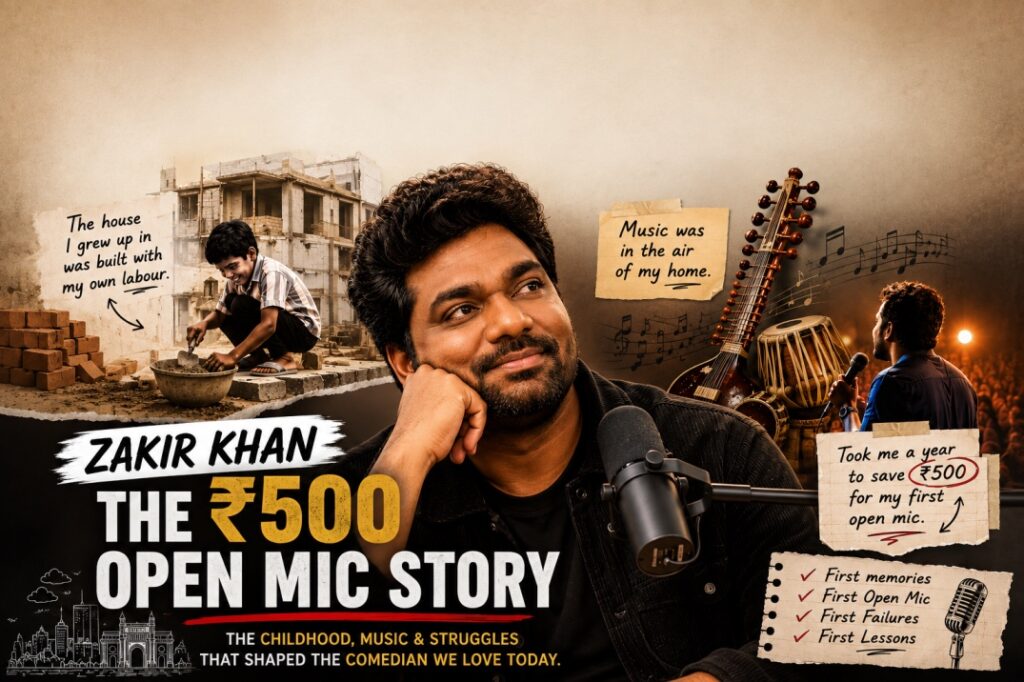
Zakir Khan ₹500 open mic story is one of the most striking memories from his conversation with Gopal Datt on Pehla Pehla. But the story becomes even more powerful when you hear what happened before that ₹500 ever reached his hands.
Long before Zakir Khan became one of India’s most recognisable comedians, he was a young man trying to figure out his career while dealing with financial struggles, uncertainty and a very different upbringing from the world of stand-up comedy.
In the first episode of Pehla Pehla, hosted by actor and writer Gopal Datt, Zakir goes back to the “firsts” that shaped his life from his childhood home and musical upbringing to his school years, his difficult days in Delhi, his first open mic and the failures that eventually helped him find his voice.
One of the most memorable parts of the conversation is the role played by his friend Vishwas, who encouraged Zakir to try comedy when the two were struggling to make ends meet.
That encouragement eventually led to a ₹500 open mic registration fee, which Zakir reportedly spent around a year and eight months saving for.
The amount may sound small today. For Zakir at that point in his life, it represented a dream.
Zakir Khan ₹500 Open Mic Story: The Struggles, Music and Friendship Behind His Comedy Journey
Zakir Khan’s Childhood Home Was Built With His Own Labour
One of the first stories Zakir revisits in the podcast is about his childhood home.
His memories of the house aren’t simply about growing up there. He remembers actually being involved in its construction.
Zakir explained that his family contributed their own labour while the house was being built. Instead of hiring four labourers, the family hired three, with Zakir effectively contributing the fourth person’s share of work.
He recalled helping with construction and learning how to mix the material used for building the house.
It is a surprisingly physical memory for someone who would eventually become known for comedy, poetry, acting and storytelling.
But it gives an important glimpse into Zakir Khan’s childhood.
His early life wasn’t separated from the realities of work and money. If something needed to be done, the family contributed. That experience of watching a home literally take shape around him would remain one of the unusual memories from his childhood.
Zakir Khan Grew Up Surrounded by Music
If construction was one side of his childhood, music was another.
Zakir’s home in Bombay Bazaar was surrounded by musicians and students learning classical music. He has spoken about growing up around his grandfather, Ustad Moinuddin Khan, a respected sarangi player, and the musical environment that existed around his family.
In the podcast, Zakir recalls memories of musicians visiting the house and students coming for lessons.
There could be music playing for hours. The sound of instruments such as the sarangi, tabla and sitar became part of his everyday environment.
He also remembered going to Akashvani for recordings and encountering musicians and singers through his family’s connections.
This is an important part of Zakir Khan’s music background because music wasn’t something he discovered after becoming famous. It was woven into his childhood.
His grandfather’s influence also introduced him to the discipline of musical practice. Zakir trained in sitar and has spoken previously about the importance of riyaaz and the values he learned from his family.
The Musical Lessons That Stayed With Him
Zakir eventually became known for stand-up comedy rather than classical music. Yet his musical upbringing may help explain his distinctive approach to storytelling.
Comedy has rhythm.
A punchline needs timing. A story needs pauses. A performer needs to understand when an audience is listening closely and when a moment needs silence.
Those principles aren’t completely different from music.
Growing up around classical performers meant that Zakir was exposed to performance, discipline, practice and audience response from an early age.
His eventual career may have taken him away from the classical stage, but music remained part of the foundation on which his creative personality developed.
Zakir Khan’s School Years and the Search for a Direction
As Zakir moved through his school years, his future wasn’t yet clear.
His family had a strong musical legacy, but Zakir’s interests were moving in other directions.
He eventually studied biotechnology, but the conventional academic route did not become his career.
Instead, his interest gradually moved towards communication, radio, writing and performance.
Delhi became an important chapter in that journey.
And it was in Delhi that Zakir’s life began moving closer to comedy.
But before the success, there was a period of serious struggle.
The Time Zakir Khan and Vishwas Struggled for Food
Perhaps the most emotional story from the Pehla Pehla conversation comes from the period when Zakir was living in Delhi with his friend Vishwas. The two were struggling financially.
This wasn’t the kind of struggle where they simply had to cut down on luxuries. At times, food itself became difficult to afford.
Zakir recalled a period when they would sometimes eat only once a day, and there were occasions when they went without food for days.
It was during this extremely difficult period that Vishwas encouraged Zakir to consider comedy. And that advice became one of the biggest turning points in his life.
Vishwas Told Zakir Khan He Should Do Comedy
Vishwas saw something in Zakir that Zakir himself was still trying to understand. While the two friends were struggling, Vishwas encouraged him to start doing comedy.
His belief was simple: if Zakir pursued comedy seriously, there was nobody better suited to do it than him.
It was a remarkable thing to hear from a friend at a time when Zakir wasn’t successful, financially secure or even established as a comedian.
There was no guarantee that comedy would pay the bills. There wasn’t even a guarantee that Zakir would succeed on stage. But Vishwas believed that Zakir had something special. That encouragement gave Zakir another possibility to consider.
Maybe comedy could be more than something he enjoyed. Maybe it could actually become his work.
And that possibility eventually led him towards his first open mic.
Rajneesh Kapoor’s Message That Changed Everything
Around the same time, another important moment of encouragement came from Rajneesh Kapoor, who played a quiet but meaningful role in Zakir’s early journey.
Rajneesh Kapoor sent Zakir a long message that stayed with him deeply. In that message, he told Zakir that making people laugh is a very good job, and if you are able to do that, it is something truly great.
For someone who was still unsure about choosing comedy as a career, those words carried weight. It wasn’t just encouragement, it was validation that comedy itself was a meaningful profession.
Zakir later responded to that message with a simple but powerful line:
“I’m here definitely to stay.”
That reply reflected a shift in mindset. Comedy was no longer just an experiment or a side interest; it was becoming a commitment.
Zakir Khan Discovered Stand-Up Comedy
Zakir began looking more seriously into stand-up comedy.
At the time, the comedy scene was nowhere near as mainstream as it is today. For someone trying to enter it without money or connections, simply finding a place to perform was itself a challenge.
Eventually, Zakir discovered that an open mic opportunity required a registration fee of ₹500. There was just one problem.
He didn’t have ₹500. For someone who was already struggling to afford food, ₹500 wasn’t spare change.
So Zakir had to wait.
The Zakir Khan ₹500 Open Mic Story
This is where the now-famous Zakir Khan ₹500 open mic story begins.
And behind that money was Vishwas’s belief in him and the encouragement he had received from Rajneesh Kapoor that comedy was worth pursuing.
The story therefore isn’t simply about the price of an open mic.
It is about what someone is willing to sacrifice for an opportunity when there is absolutely no guarantee that the opportunity will change their life.
Eventually, Zakir managed to save the money and register.
The first step had finally become possible.
His First Open Mic Didn’t Make Him a Star
Saving ₹500 and getting onto a stage was only the beginning.
The first open mic did not instantly transform Zakir into the comedian audiences know today.
There were performances that worked and performances that didn’t.
There were failures.
There was experimentation.
There was the process of figuring out what kind of comedian he wanted to become.
That period is important because Zakir’s later success can sometimes make the early struggle look much simpler in retrospect.
It wasn’t.
He had to learn how to write jokes, structure stories, handle an audience, recover from a joke that didn’t land and develop a performance style that felt authentic.
From Radio to Comedy
Before comedy became his full-time identity, Zakir was also associated with radio.
His early professional years involved trying different things while attempting to establish himself.
Radio gave him experience with voice, communication and audience engagement.
Comedy gave him a stage where he could combine those skills with his own experiences.
His rise was gradual rather than instant.
Eventually, he won Comedy Central’s India’s Best Stand Up competition in 2012, a major milestone in his professional career.
But by the time that breakthrough arrived, Zakir had already spent years learning how to perform.
The ₹500 open mic was one of the earliest steps in that journey.
His Early Failures Became Part of His Learning
One of the reasons Zakir’s story resonates with audiences is that he doesn’t present his journey as a perfect sequence of victories.
Failure was part of it.
The early performances taught him what worked and what didn’t.
More importantly, they taught him how to turn everyday experiences into stories.
That eventually became one of Zakir’s biggest strengths.
Instead of relying only on traditional punchline-based comedy, he developed a storytelling style rooted in personal experiences – family, friendships, relationships, heartbreak, awkward moments and growing up.
The ordinary became material.
The experiences that might have seemed insignificant at the time eventually became stories that audiences could recognise themselves in.
Why Zakir Khan’s Childhood Matters to His Comedy
Looking back at the stories Zakir tells in Pehla Pehla, there is a clear connection between his childhood and the comedian he eventually became.
The house being built around him exposed him to the value of labour.
His musical upbringing exposed him to rhythm, discipline and performance.
His school years were part of his search for direction.
His difficult days in Delhi taught him what uncertainty felt like.
Vishwas gave him encouragement when he needed it most.
Rajneesh Kapoor gave him validation that comedy was a meaningful profession.
And the ₹500 open mic taught him what it meant to pursue an opportunity even when getting there was difficult.
None of these experiences alone created Zakir Khan.
Together, they helped shape him.
The Zakir Khan ₹500 open mic story isn’t really a story about ₹500.
It is a story about belief. It is about friends and mentors recognising someone’s potential before the rest of the world did. It is about pursuing a dream when even basic necessities were difficult to afford.
And it is about continuing after the first performance, even when the journey ahead remained uncertain.
From a childhood surrounded by music to a home he helped build, from difficult days with Vishwas and Rajneesh Kapoor’s encouragement to the first open mic he painstakingly saved for, Zakir Khan’s journey is filled with experiences that eventually became the raw material for his storytelling.
Before millions laughed at his jokes, there was a young man simply trying to find his way.
And sometimes, all it takes to change that direction is one friend—or one message—saying, “You should do this.”
Also See








 Because entertainment never stops! CelebsAdda brings you fast, reliable, and spicy updates from the world of cinema, television, and celebrity culture anytime, anywhere.
One Response